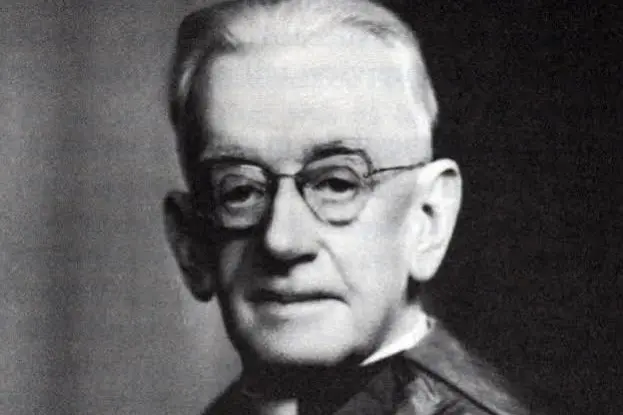
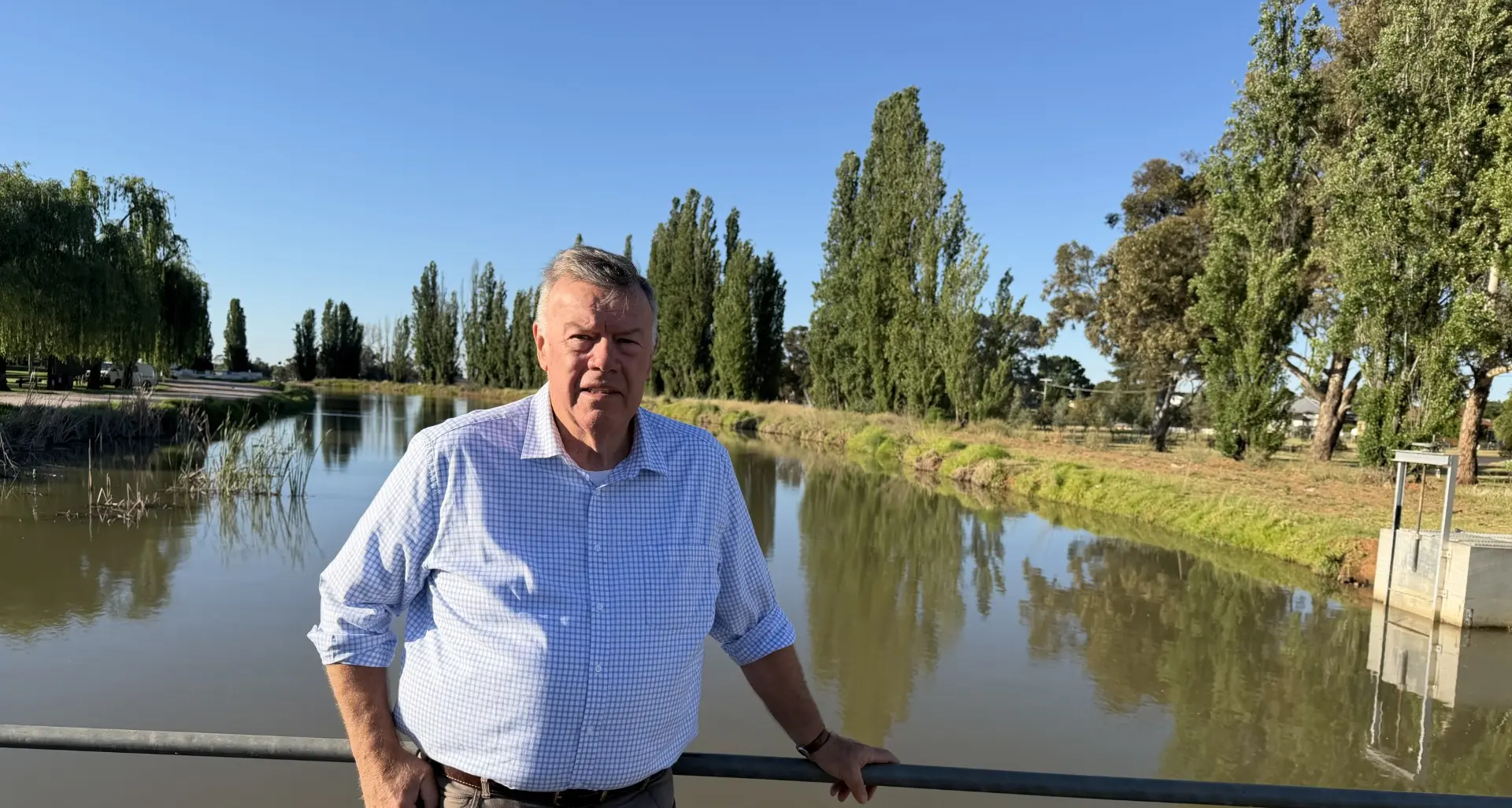
A family connection to one of Australia’s best-known bush poems brought visitors from Ireland and Townsville to Lockhart recently to explore the local history behind the name “Hanrahan”. Willie Cowman, from Ireland, and his son Peter, from Townsville, are relatives of Father Patrick Hanrahan, Lockhart’s Catholic priest from 1903 to 1933. They visited Lockhart’s Greens Gunyah Museum to see the wooden trunk Father Hanrahan used when he came to Australia, and were welcomed to morning tea hosted by local Catholic women. Parish Council chair Larry Smith and Historical Society president Mandy Strong greeted the visitors before accompanying them to Lockhart’s Catholic church and school. Both stand on land obtained by Father Hanrahan. The family also visited the cemetery to place flowers on his grave. Together, the trunk, church, school and cemetery traced Father Hanrahan’s story: his arrival in Australia, his work in the district and his final resting place. For Willie and Peter, the visit was not only an exploration of a literary mystery, but a chance to encounter their family history more closely. The visit revived a question that has intrigued some members of the Lockhart community for generations: did Father Patrick Hartigan have Lockhart’s priest in mind when he wrote “Said Hanrahan”? Hartigan, the priest of Narrandera, wrote Australian bush poetry under the pen name John O’Brien. “Said Hanrahan” first appeared in July 1919. A few years ago, Willie’s brother Jim contacted the museum and observed that it was striking that Hartigan had used the surname of his fellow priest for the poem’s central character. Whether the poem’s Hanrahan was inspired by Lockhart’s Father Hanrahan is impossible to know. But the connection has given the poem a particular local resonance. In A Land Fit for Heroes, Chris Madden’s book about First World War soldier settlers, Marie McGrath recalled the priest as “Father Hanrahan, Irish and cranky” - a description that may bring to mind the poem’s famously gloomy voice, though it cannot establish that the two Hanrahans were one and the same. The poem opens outside a church on a frosty Sunday morning, with Hanrahan warning of disaster: “We’ll all be rooned,” said Hanrahan, “In accents most forlorn, Outside the church, ere Mass began, One frosty Sunday morn.” From there, the poem follows the familiar Australian cycle of drought, flood and bushfire. Hanrahan’s predictions grow more dire as the weather changes, giving the poem its humour and its enduring familiarity. His catchphrase, “We will all be rooned,” has become a memorable Australian expression, often used to puncture predictions that everything is about to go wrong. The opening drought is described as the worst since “the banks went bad”, an allusion to the financial crisis of the 1890s. The Riverina endured a severe drought in 1914, while the years that followed brought good seasons. That contrast between hardship and recovery reflects the poem’s central comic tension: the landscape can be harsh and unpredictable, but Hanrahan is ready to declare ruin whatever the forecast. During the museum visit, Historical Society member and museum volunteer Dianna Alexander recited the poem for the visitors and others present. Her reading brought the familiar lines to life in the very district whose history has long been linked, however uncertainly, with their central character. The connection may never be proved. Yet the trunk, the church and school on land secured by Father Hanrahan, and his grave in the local cemetery give the family’s visit a tangible link to Lockhart’s past - and offer a fresh reason to hear the old poem with local ears.