PHOTO
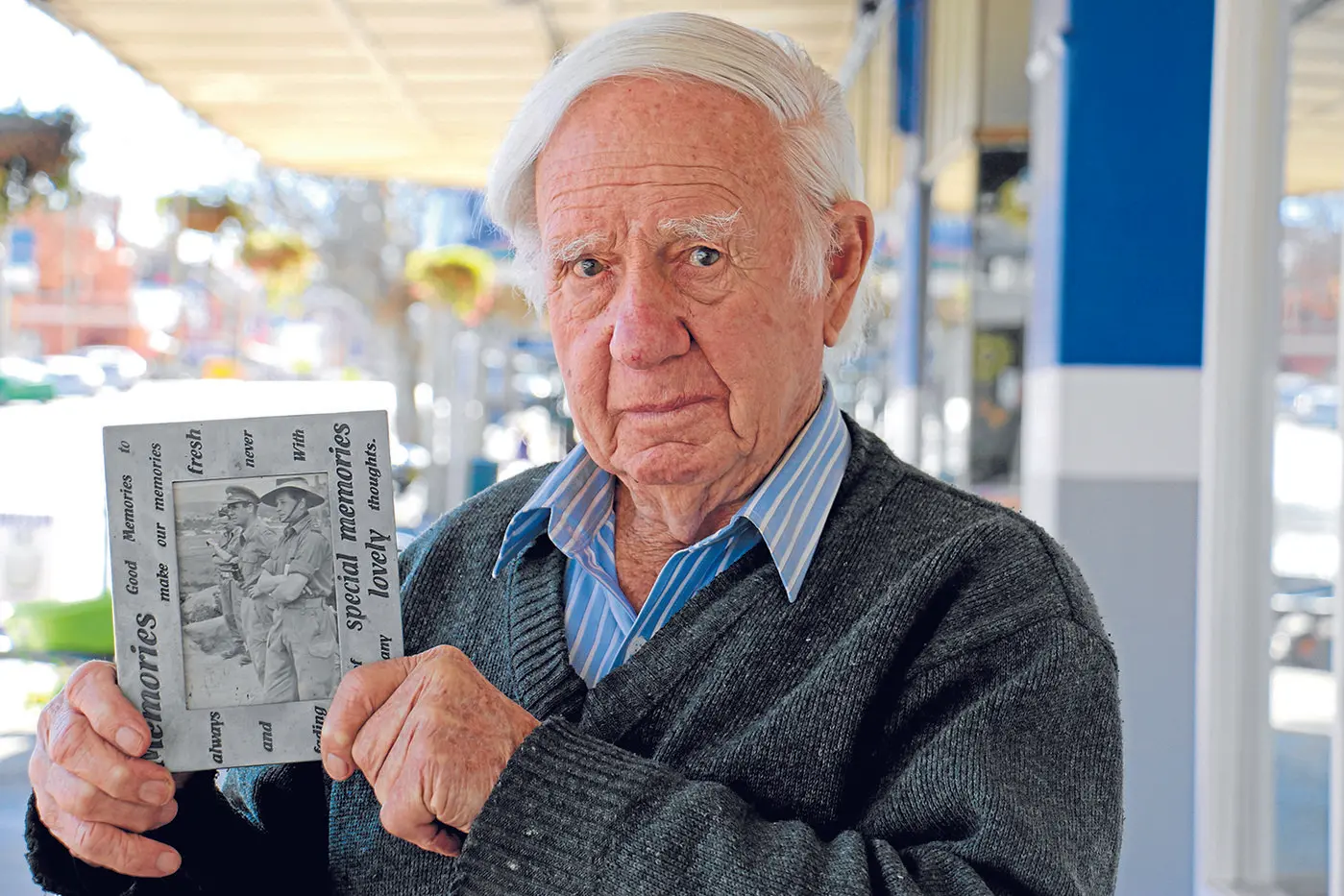
Narrandera’s sole Korean veteran John Sullivan is quietly marking the 70th anniversary of the war, remembering the good times with his mates.
Last week, John, 91, and his wife Molly celebrated 65 years of happy marriage.
This month he will head off to Wagga to take part in a ceremony to mark the 70th anniversary at the war memorial and meet up with three other Korean veterans.
The son of Pine Hill school teacher Bill Sullivan, John always wanted to pursue an army career and was accepted at Duntroon Military College, Canberra, at the age of 18 in 1948.
Bill Sullivan had served in the Volunteer Defence Corps during the Second World War and was secretary of the War Agricultural Committee in Narrandera.
“The committee was unpopular with farmers as it restricted the amount of petrol and tyres they could get,” John said.
The years after the Great Depression left a mark on his young mind as a child, with the sight of swagman looking for work and families camping on the Narrandera Common.
“My friend, Arthur Hathaway, had a pair of short trousers and a man’s coat as his only clothing for the year,” John said.
“It was tough times – my father had his teacher’s pay cut by 50 per cent.”
Handling firearms was part of life in those days and John even used his father’s shotgun during a shoot in East Street to control pigeons.
Aged 15, he remembers a Beaufighter from the Pacific Islands refuelling at Narrandera and the pilot offering a lift to six of the ground staff at Narrandera to see the town from the air.
John watched it fly over the Catholic Church then turn to fly over the main street when it crashed into the canal bank, killing all on board.
He rushed to the site to be confronted with a horrific scene.
John completed a four-year course at Duntroon, graduating in 1951 just in time for the Korean War.
He had a brief stay with the 13th National Service Battalion and then on to Korea serving with the 1st and 2nd RAR battalions.
The 1RAR battalion was noted for its attack against Chinese positions at Hill 227 (Operation Blaze) and Operation Fauna.
In the days before the signing of the armistice, 1RAR fought the last action of the War at the Hook when they were attacked by a large number of Chinese troops.
During the course of the War, about 17,000 Australian military personnel serviced with 340 killed, 1216 wounded and 29 prisoners of war.
A Lieutenant Commander, John likened the conditions to the trench warfare of the First World War.
He said the soldiers battled mud and freezing winter conditions but they were issued with warm British uniforms.
“If you got frost bite you were charged with a self-inflicted wound as you weren’t looking after yourself,” he said.
“In all my time there, I only dealt with one coward – the Australian troops were the greatest young men I could have ever met.
“They were outstanding and I was lucky to be with them.”
John said, unlike with Vietnam, the war effort was support on the home front as people understood the fight was against communism.
“It was a popular, if you like, war, not like Vietnam.
“It was mainly night warfare – I don’t think we slept at night at all, it was basically patrolling or being shelled by the enemy.
“We had respect for the Chinese soldier, tough and he lived under terrible circumstances.
“We lived in trenches with bits of barb wire from shelling, bits of bodies around and rats.
“When you are young you accept that as part of life and get on with it. You keep your sense of humour.”
The soldiers went in to the line for six weeks then onto reserve for a break, often filling in the time by playing football.
John recalls an accident involving a C17 Globemaster military aircraft where 130 US soldiers were killed, rated as the world’s worst air crash at the time.
“You took it as part of life,” he said.
“The company next door had a terrible accident at the listening post – a fellow standing on a bag full of grenades accidentally pushed a pin out, with three dead and six wounded.
“We had to take the stretcher bearers down there to get the wounded out.
“We couldn’t get them through the trenches because of the length of the stretcher so we had to go over the top.
“We were being shelled but as we got over the parapet towards open ground, the shelling stopped and I reckon it was the Chinese fire controller who saw the stretchers and stopped the fire.
“I have a great deal of respect for the Chinese.”
He recalled the battle at the Hook when the Australian soldiers were left in the open by their US counterparts.
All but two US soldiers made themselves scarce except for two manning a machine gun pit, killing around 70 enemy soldiers.
John completed a year in Korea followed by a year in Japan serving as chief instructor for the Australian reinforcements battle school.
It involved live firing exercises over a six-week course.
“The welcome home to Narrandera was tremendous – they wanted to put a parade on but I wouldn’t have a bar of it.”
As a professional soldier, John went on to served in Vietnam and ended up at Kapooka as a Lieutenant-Colonel before resigning from the army.