
PHOTO
In the heart of the Riverina, where the skyline is defined by concrete giants rather than skyscrapers, the township of Matong is proving that regional relevance is measured by utility, not just population.
With approximately 160 residents, this specialised agricultural hub continues to operate as a vital “silo town”, anchoring the NSW grain network as the 2026 season moves into high gear.
The story of Matong began long before the first rail lines were laid. Situated on the traditional lands of the Wiradjuri people – who managed the region for over 60,000 years -the area’s name translates to “Great Water” or “Strong”, a reference to the local lagoons.
Modern Matong was formally surveyed in 1882 to serve as a critical siding for the South Western Railway. Its location was strategically chosen to provide water for steam locomotives.
Over the last 140 years, the town has transitioned from horse-drawn drays to high-efficiency rail-loading, adapting seamlessly to the shifting demands of global agriculture.
Matong’s geography places it at the centre of the Riverina’s most productive corridors. Located on Canola Way Highway which runs between the M1 Motorway at Gundagai and Newell Highway at Grong Grong.
The town sits 28km east of Narrandera, 14km east of Grong Grong, 34km west of Coolamon, 70km west of Junee, and, 65km northwest of Wagga Wagga and 125km south of West Wyalong.
The local economy is currently benefiting from the recent completion of major upgrades to Kelley’s Bridge on Matong Road. This infrastructure project has significantly boosted transport efficiency for the 2025/26 winter crop.
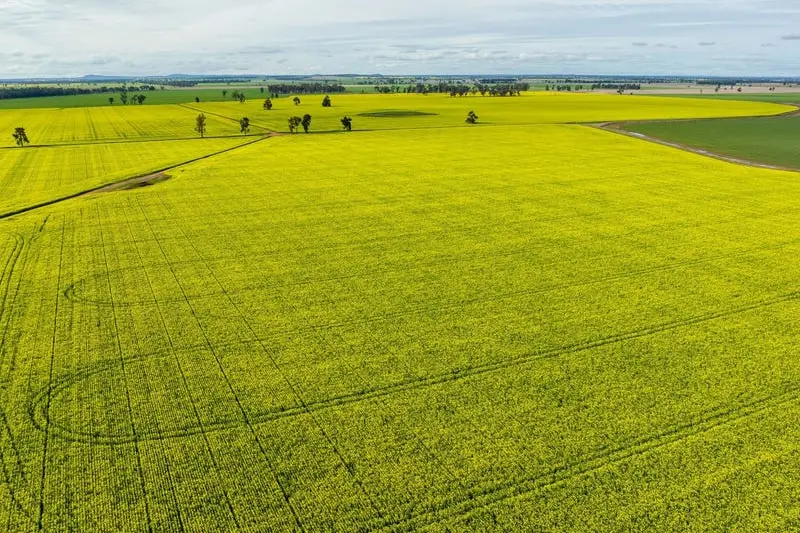
High-volume yields of wheat and canola are currently moving smoothly from farm gates to the Junee-Narrandera rail line, a critical node for domestic and export markets.
With high-protein wheat in strong demand for the second quarter of 2026, the local silos remain the most important fiscal symbol in the landscape.
While grain is the economic backbone, the community remains the town’s spirit.
This past Tuesday, residents showcased the town’s active demographic by attending the annual Seniors Dinner in Ganmain as part of NSW Seniors Week.
Many of these attendees are intergenerational farmers, still working properties established during the original 1882 survey.
In the absence of a large commercial precinct, Matong’s social fabric is maintained by three enduring pillars: 1. Matong Public School, 2. The Football and Netball Club and 3. The Matong Parks and Resources Committee.
These institutions ensure that the village maintains a distinct identity, independent of larger neighbours like Narrandera or Wagga Wagga. As Matong enters the mid-2020s, it stands as a specialised and productive village – a community whose strength is found in its deep-rooted connection to the soil.