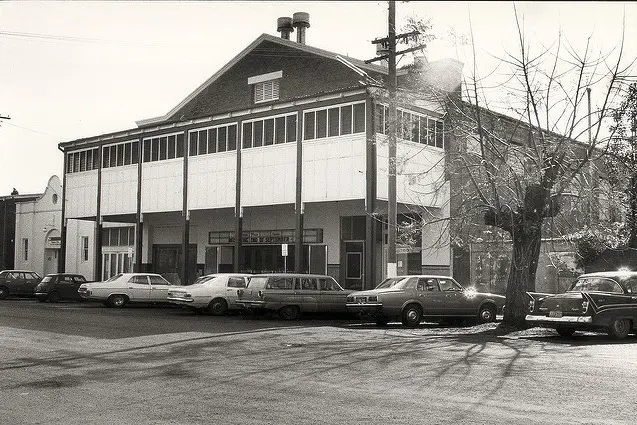
Narrandera’s grand old Plaza Theatre is turning 100 years old and the current owners the Christian Revival Crusade plan to celebrate the occasion with a concert this Saturday. Formerly the Globe Theatre it was opened in 1927, replacing an earlier Globe Theatre at a different location which was destroyed by a fire. The ‘new’ Globe Theatre was damaged by a fire on 1 June 1934. Repairs were carried out and it re-opened as the Plaza Theatre on 31 October 1934. Seating was provided for 500 in the stalls and 356 in the circle, to total 856. When CinemaScope was installed in 1955, the proscenium was altered and the seating capacity was increased to 1028. The Plaza Theatre was closed in 1983. It was taken over by the Christian Revival Church (CRC) which operates in the stalls area only. A false ceiling has been inserted across from the front of the circle, which remains intact, with the seats still in place, but this section of the building is no longer in use. It is also the venue for some wonderful concerts and events organised by the community. The Globe Theatre started as an open-air picture palace in 1910 at 94 East Street (with winter screenings held in an adjacent hall). KEY TIMELINE AND HISTORY Early Beginnings (1910–1922): The first films in Narrandera were screened at the open-air Globe Theatre. In 1922, Nicholas (Nick) Laurantus took over the lease, using it to launch a successful chain of regional cinemas in south-western New South Wales. Destruction and Rebuilding (1925–1927): The original East Street public hall and Globe Theatre burned down in 1925. Laurantus rebuilt a brand-new Globe Theatre at 33 Bolton Street, which officially opened in 1927. The "Talkie" Era (1930): The first talking picture (talkie) was screened at the Bolton Street Globe on 7 June, 1930. Fire and Rebranding as the Plaza Theatre (1934): A fire damaged the Globe Theatre on 1 June, 1934. Following repairs, it re-opened as the Plaza Theatre on 31 October, 1934. Later Operations and Closure: CinemaScope was installed in 1955, expanding the seating capacity. The cinema officially closed in 1983. The building at 33 Bolton Street is currently used by the Christian Revival Church, utilising the stalls level while the original circle remains intact above. Sir Nicholas (Nick) Laurantus (1890–1980) built a prominent regional cinema chain across south-western New South Wales between 1922 and 1938. Starting with the lease of Narrandera's open-air Globe Theatre, he partnered with relatives from his native island of Kythera to bring moving pictures to rural communities. Origins and Expansion • Background in Regional NSW. Born in Kythera, Greece, Laurantus migrated to Australia and initially worked in cafés and hotels across regional towns such as Young and Cowra. After a failed wheat farming venture near Cowra in 1921 left him nearly broke, he relocated to Narrandera in 1922. • Launching in Narrandera. He acquired the lease of the open-air Globe Theatre and pledged in the local newspaper to show "the best and latest productions in the way of moving pictures". When fire destroyed the original venue in 1925, he invested in rebuilding a permanent theatre on Bolton Street in 1927 (later renamed the Plaza Theatre after a 1934 fire). • Family-Run Regional Network. Using Narrandera as a base, Laurantus expanded his theatre holdings across the Riverina and south-western New South Wales. He brought out his brother George and other family members from Kythera to help manage and operate the growing circuit. • Breaking the Greek Café Mould. At a time when most Greek immigrants in rural Australia were concentrated in cafés and refreshment rooms, Laurantus pioneered entry into cinema exhibition, hotels, and pastoral properties. He actively mentored and financially backed younger Greek migrants looking to establish businesses in regional towns. Transition and Legacy • Shift to Grazing (1938). After 16 years in cinema exhibition, Laurantus pivoted toward large-scale agriculture in 1938 by purchasing Windella station near Narrandera. He went on to acquire major pastoral holdings, including Lake Midgeon station, which housed one of the largest shearing sheds in New South Wales. • Philanthropy and Honours. The wealth generated from his cinemas and grazing properties funded major philanthropic initiatives. He donated $100,000 in 1968 to establish the Chair of Modern Greek at the University of Sydney and contributed roughly $450,000 to St Basil's Homes for aged care. He was appointed an MBE in 1977 and knighted in 1979. Sir Nicholas was a businessman and philanthropist, was born on 5 February 1890 on the island of Kythera, Greece, third of twelve children of Panayiotis Lourantos, contractor, and his wife Angeliki, née Marsellos. After seven years of schooling, Nicholas helped his father as an apprentice carpenter and blacksmith. Letters from relations overseas stimulated his desire to emigrate. When a cousin at Grenfell, New South Wales, offered to look after him, Nick and his younger brother George sailed for Australia in the Seidlich, reaching Sydney on 1 November 1908. Nick began work in the Thermopylae Café at Grenfell for 7s. 6d. a week, with accommodation above the shop. He determined to learn English in three months and kept a dictionary beside his bed, constantly checking and memorizing new words. Frugal and hardworking, by 1913 he had saved enough money to buy the café in partnership with an American relation and to establish Laurantus & Co. He sent for George, who was to be a partner in many of his later business ventures. In 1914 Nicholas Laurantus acquired the lease of the Albion Hotel at Young. At St John's Anglican Church, Cowra, on 29 March 1920 he married Clare May Barker (d.1954), a 33-year-old housekeeper. Three hotels later, in 1921, he decided to try farming, and took his wife and baby daughter to a small wheat farm near Cowra. He chose a bad year and almost lost his money. In 1922 he moved to Narrandera where he acquired the lease of the open-air Globe Theatre, announcing his intention in the local newspaper 'to show before Narrandera audiences the best and latest productions in the way of moving pictures'. The Globe marked the start of a successful chain of cinemas across south-western New South Wales which he ran with the aid of George and other family members whom he brought from Kythera. In 1938 Laurantus bought Windella station near Narrandera; he later acquired other properties, including Lake Midgeon station which reputedly had the largest shearing shed in New South Wales. In a few years he was very wealthy. One of his managers said of him, 'Nick was purely a financier but he did have this love of the land. His knowledge was such that he could look into the future and say, ''Wool's going to be good, so we'll grow sheep", or, at another time, ''Wheat's going to be good, so we'll farm country"'. Laurantus went out of his way to advise young Greek immigrants and assist them financially. By breaking out of the café circuit and venturing into cinemas, hotels and grazing, and by being completely at ease in both Greek and Anglo-Australian society, he set an example for other Greeks: if they learned English, mixed with Australians and worked hard, they too could succeed. At the same time he felt that Greek immigrants should know and love their own language and culture. In 1968 he gave $100,000 to establish a chair of modern Greek at the University of Sydney. During the 1970s he donated about $450,000 to St Basil's Homes in Australia for aged people. Lourantos Village at Lakemba was named after him. Appointed M.B.E. in 1977, Laurantus was overjoyed to be knighted in 1979 and described his investiture at Government House, Canberra, as the happiest day of his life. From 1968 he had lived in Sydney at the Masonic Club. A frail but stubborn old man, still fond of jokes and good company, Sir Nicholas died on 26 July 1980 at Greenacre and was buried in the Greek section of Botany cemetery. His only child Helen survived him.