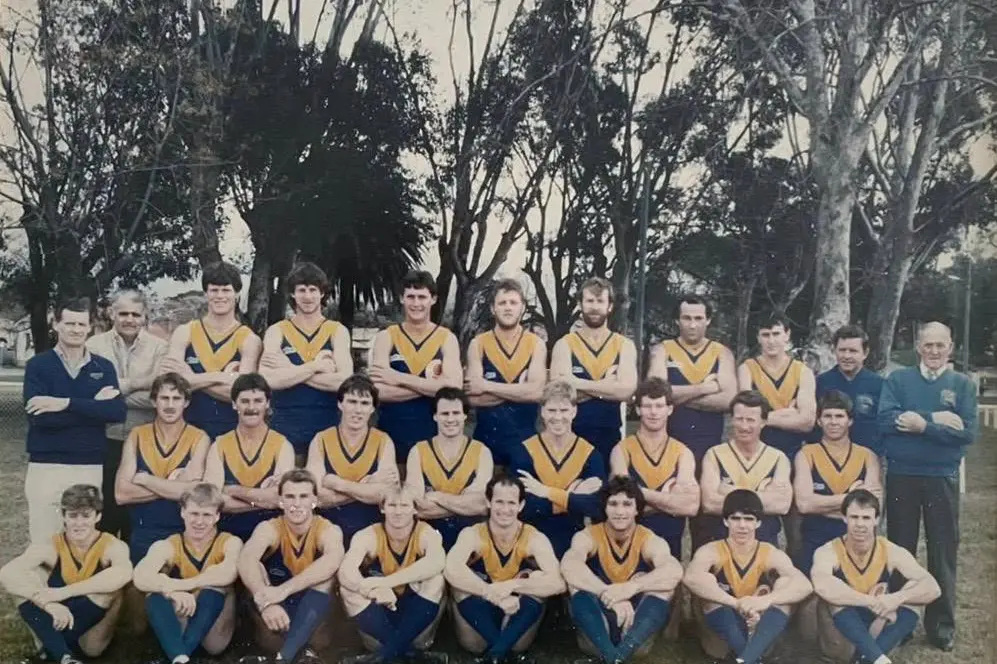
Forty long years have passed since Narrandera won the first of its only two Riverina Football League (RFL) premierships on the back of a best-on-ground performance in the Grand Final by a player who tragically lost his life just seven weeks later. Paul Werner was an ambitious man going places and it was so sad he passed away at just 24 years young. His death, in an early morning car crash, had a profound influence on his adopted club, even though he wore the famous blue with a gold V only nine times. Narrandera, hit hard by Werner’s death and beset by a number of big names leaving after the 1986 flag, did not come close to playing finals football again until 1998 and did not win the competition again until 2012. The proud club’s lack of success in recent decades has really stung supporters, given Narrandera was the powerhouse town – in terms of both ground and glory – in the old South Western District Football League (SWDFL), which was the pre-eminent competition in country New South Wales from 1913-81. The magnificent and spacious Narrandera Sportsground – unquestionably the greatest oval in country football – rightly hosted the last 32 SWDFL Grand Finals and has staged 41 of the 43 RFL deciders. Indeed, the Imperials, as Narrandera was long known, won 15 South West flags – more than any other club. Ganmain won 14 premierships, Leeton eight, Coolamon Rovers five, Turvey Park four, Ariah Park-Mirrool three, Griffith, Marrar and Matong two each and Junee one. Narrandera followers are buoyed by their Under 17.5-18s winning the 2025-26 premierships. If the majority of this teenage talent can find employment and opportunities in the district and stay together as a group, then that could well lead to senior success in the future. RECRUIT Paul Werner joined the Imperials from Cairns in Queensland mid-season in 1986, with Narrandera sitting third behind Ganmain-Grong Grong-Matong (GGGM) and Turvey Park at the time. His new team was captain-coached by 33-year-old Richard “Curly” Manouge, described in the Grand Final Record that year as “crafty, wily, cagey … all of these labels can be applied to this ageing centreman. Sets up much of Narrandera’s play with his imaginative hand ball.” Old-time sports writer Dan Clarke (1915-2000) was a regular fixture in the Narrandera press box each home game and would lament the modern game’s “fandangle” hand passing. “Why can’t they just kick the damn thing?” he’d moan. “I’ve yet to see a player who could hand ball further than he could kick.” But Manouge was the exception. The former South Australian National Football League (SANFL) star – eight years with West Torrens and one with Port Adelaide – took on Narrandera after 1985 leader and Jim Quinn Memorial Medallist Russel Durnan moved to Victoria to try his luck with Essendon and Geelong. Manouge could play. Hard and tough, he directed the game and brought others into the action with his long, accurate hand passes. Werner arrived in town just after another recruit, policeman Harvey McRae, a NSW representative player, landed locally from Sydney’s Western Suburbs. On debut, Werner lined up against Turvey Park and Tim Finemore, one of the best centre halfbacks around. Werner lived up to his reputation, particularly in the first half when he had nine kicks and held seven marks at Maher Oval, Wagga Wagga, on 13 July. A goal on the run by dashing winger Ian Bloomfield just seven seconds from full-time broke a deadlocked score and gave the Imperials a thrilling six-point win. This enabled Narrandera to leapfrog Wayne Carroll’s Bulldogs into second spot, a position it kept until finals. The final ladder in 1986 had GGGM minor premier with 60 points on percentage from Narrandera (also 60), with Turvey Park next on 48 and Wagga Tigers 44, squeezing Griffith out of the finals on percentage. East Wagga-Kooringal finished seventh, winning only eight from 18, but that did not stop Hawks’ 35-year-old wizard of a full forward Trevor Sutton from kicking 140 goals, including 21.12 at Ardlethan on 13 July, individual records which, given the way the game is now played, may never be beaten. GLORY BOUND All 1986 finals matches were staged on a Sunday at Narrandera. The 31 August First Semi-Final was one of the most sensational and brutal games for some time; Wagga eliminating Turvey Park by three points – 14.15 (99) to 15.6 (96) – the third time in five years the Tigers had knocked out the Bulldogs. Turvey Park led by 40 points midway through the third quarter but faltered after a dramatic all-in brawl lasting several minutes. The fight happened after Turvey Park youngster Chris Masterson was felled … Wayne “Christmas” Carroll racing 30 metres to “square up”. The defeat stung Carroll … he realised his team was not September fit and he made sure that would not be the case again, driving his players relentlessly, with the Bulldogs going on to win four consecutive premierships (1987-90), something no club had ever accomplished in the SWDFL or its forerunner, the Ganmain Football Association, or even the Farrer League. GGGM was first into the Grand Final, brushing aside Narrandera in the 7 September Second Semi-Final 19.13 (127) to 14.14 (98), with Lions’ leader Mark Fraser best afield in the centre. Fraser, the former South Melbourne player, was out for redemption. As the Record stated: “(He) had the team to win the flag last year but two close finals losses robbed him of being a first season premiership coach.” The Imperials qualified for the decider with a barnstorming 15.5 (95) to 7.10 (52) Preliminary Final win against Wagga on 14 September; Manouge having 11 kicks and 11 hand passes and three goals before resting for the final 20 minutes of the game. It was all set up for a classic Grand Final … the two titans of the old SWDFL playing off in the RFL with GGGM, the 1984 premier, having a 2-1 advantage in 1986 on the back of a 45-point win at home on 1 June and their previous finals encounter. An undermanned Narrandera had beaten the Lions by just four points at Narrandera on 10 August. Most tipsters predicted another GGGM title, with only Leeton’s non-playing mentor Max Kruse and Ardlethan selector Stewie Litchfield plumping for the Imperials. So the stage was set for a memorable afternoon and one Paul Werner would make his own as Narrandera romped home by nine goals – 19.7 (121) to 9.13 (67) – at Narrandera. It was the most one-sided Grand Final since 1946 when Ganmain, captain-coached by Ivan McKay, thrashed Narandera (that’s how the town name was spelt until 1949), by 71 points at Matong Sportsground in the first SWDFL competition after a five-year recess for World War II. Sunday 21 September 1986 was the day a big, bearded 187-centimetre-tall gun recruit who came to town because he needed a job (in parks and gardens) and to play a bit of football, stepped up to earn man-of-the-match status, long before a medal was awarded for such an effort. A medal honouring famed football administrator Ron Hutchins (1908-88) was first awarded to the RFL Grand Final best on ground in 2000, with GGGM’s Shane Lenon the inaugural recipient. As my report the following day outlined: “Centre half forward Paul Werner, who came to the club mid-season, initiated some lovely moves early in the match and was always doing something creative. “Werner held six strong marks and kicked four goals, two in the opening quarter, one in the third and the other, a memorable effort, in the last term. “His final goal typified the game itself. “Narrandera led by six goals 11 minutes into a tight final session and, through sheer persistence and pressure, forced Ganmain’s backline into error. “Werner strode in, gathered the ball calmly on the run, stepped around back pockets Greg Menzies and Craig Bryon with arrogant ease and goaled on the run.” ALL-TIME GREAT Another star was Victor Hugo, one of the greatest players Narrandera ever produced. Making his debut as a 16-year-old on 26 April 1970, wearing No. 46 against Griffith at Narrandera, Hugo booted the first of his 915 club goals over what would be a record 341 games for the Imperials across 11 SWDFL and 13 RFL seasons. Remarkably, 11 of his seasons with the Imperials were spent in defence, where he preferred to play. Hugo, who proudly wore No. 14 from his second senior season, won the Kiesling Trophy as league leading goalkicker twice (1971 at age 17 and in 1985) and topped his club’s goalkicking a remarkable 11 times. Surprisingly, he won only one club best and fairest, in 1979 – the year he played at fullback all year until the final round against Turvey Park when he kicked seven then followed it up with two performances against Ariah Park-Mirrool which still make old-time Brown Bombers’ supporters shudder. In the Second Semi-Final, Hugo slotted 11.1 and backed it up with 11.2 in the Grand Final as Narrandera swept to a 16-point win on a day when the club won the First Grade, Reserves and Under 19 pennants. They still talk about those feats of Hugo brilliance to this day. The only year Hugo spent away from his beloved Narrandera was 1977 when he captain-coached Coleambally to its second successive premiership in the old Coreen and District League, which folded in 2007 after 99 years of competition. The league comprised (in 1977 Home-and-Away finishing order) Coleambally, Buraja, Daysdale, Wahgunyah, Boree Creek, Coreen, Oaklands, Rennie and Urana. Sadly, in 2026, only Coleambally (Farrer League), Rennie (Picola League) and Wahgunyah (Tallangatta League) remain as clubs in their own right. Hugo kicked three goals in a tight Grand Final which resulted in Coleambally, wearing blue and maroon, edging out the Daysdale Magpies, led by Daryl Bruton, by three points – 10.16 (76) to 10.13 (73) – at Oaklands. Enticed to Melbourne once more by a persistent South Melbourne, Hugo held his own at centre halfback in two games for the Bloods in the Victorian Football League (VFL) in 1980 but didn’t like the “big smoke” so he packed his bags and duly returned home to play out the year at Narrandera. In 1986, Hugo kicked 88 goals in the minor rounds before kicking five in the Second Semi, two in the Preliminary and five until three-quarter time in the Grand Final (to give him 100 for the season) before being shifted to centre halfback to nullify GGGM’s talented Michael Walsh. Walsh had kicked a last-gasp goal to snatch victory for the Lions in the epic 1984 decider against Ariah Park and the Imperials, despite leading by 41 points at the last change, were not taking any chances. Narrandera need not have been concerned as the Imperials, with winners everywhere, forged ahead. Lanky 200cm Mark Clark and fullback Joe Hopwood repeatedly punched the ball away from Ganmain’s forwards and halfback flanker Stephen Donaldson and Mick Connop were there to clear. Manouge dished out 18 hand passes and skilful winger Ian Bloomfield used his terrific pace to good effect. Rovers Gary “Gubba” Powell and Ian Royal were busy and Mick Hopwood won the ruck. “Our smothering was unbelievable,” a jubilant Manouge said afterwards. “We tackled them out of it and showed greater desire.” TRAGEDY Tragedy followed triumph for Narrandera with the town and club plunged into mourning when news filtered through that Paul Werner, hero of the Grand Final, had died in Canberra Hospital on 9 November after a car crash. Police said Werner failed to negotiate a left-hand bend on the Old Cooma Road near Queanbeyan and ran into an embankment, later succumbing to his injuries. Narrandera Imperial Football Club (NIFC) Secretary Peter Royle said: “Paul Werner was a much-travelled young man, who had a very broad and wide outlook on life. “He was possessed of a pleasant personality and was one with whom it was easy to talk and work.” Outgoing NIFC President John Rose summed up the feelings of many when he said: “It is difficult to find words to express how I feel following the news of Paul Werner’s tragic death over the weekend. “I had only known Paul for six months, however, it seemed like I had known him for years. “He was one of those very special people one meets all too infrequently in life.” Mr Rose said Paul was a very friendly person, with a polite and courteous manner. A chartered bus took players and supporters from Narrandera to the 11 November funeral at Saint Paul’s Anglican Church, Manuka. It was hard to believe such a vibrant young man with such bright prospects was gone. A chartered bus took players and supporters from Narrandera to the 11 November funeral at Saint Paul’s Anglican Church, Manuka. It was hard to believe such a vibrant young man with such bright prospects was gone. Werner had a fine football pedigree. His father Graham played 120 games for Ainslie as well as topping the goalkicking in the strong Canberra Division One competition in 1961 (with 54) and 1966 (77) whilst playing for Eastlake. The youngest of Paul’s four brothers, Michael, played the game at the highest level, having started his junior career with Eastlake in the Australian Capital Territory before transferring to neighbouring club Manuka-Weston. Michael spent the 1988 season in the SANFL with West Torrens and kicked 38 goals to head the goalkicking. In 1988 he also turned out for the ACT at the Adelaide Bicentennial Carnival. Essendon then secured Michael’s services with pick nine in the 1988 VFL Draft and he spent the next four seasons as a key forward. He kicked 27 goals in 1990 but missed that year's finals series with Essendon making the Grand Final. In 1991 he had only six senior appearances but importantly kicked four goals in Essendon's Elimination Final loss to Melbourne. At the end of the 1992 season, Michael was traded to Sydney where in his first game against his old club, and third for the Swans, he kicked a career best six goals. All up, he played 60 VFL-Australian Football League games and kicked 80 goals. He later played with Gisborne and kicked a record 173 goals in the 1997 Riddell District Football League season, a premiership year for the Bulldogs. All five Werner boys, David, Andrew, Paul, Mark and Michael – the pride of their mother Carol – played for Eastlake, with all except Mark representing ACT-NSW at junior-youth levels. Mark was Eastlake’s Under 19 captain before he gave the game away. On the day of Paul’s RFL Grand Final heroics, David was in Tuggeranong’s ACT premiership side and Michael helped Manuka-Weston win the Under 19 premiership. Paul Werner, in the brief time he spent at Narrandera, left a lasting legacy. As the centre of the RFL, both in terms of geography and due to its second-to-none football oval, Narrandera deserves its hallowed rank in Riverina football and sporting history. The late Paul Graham Werner, too, has a special place in the code at a local level and always will. * Michael McCormack is the Federal Member for Riverina and former Deputy Prime Minister of Australia. He covered the Riverina Football League for The Daily Advertiser from 1984-88.