PHOTO
Transport for NSW has given an assurance that the machine learning traffic counting and classifying cameras being installed across Narrandera Shire and the rest of the state are not used for enforcement or monitoring people in private vehicles.
Instead the is being trialled throughout NSW to analyse freight vehicles to help reduce congestion and ensure goods are delivered sooner and more efficiently.
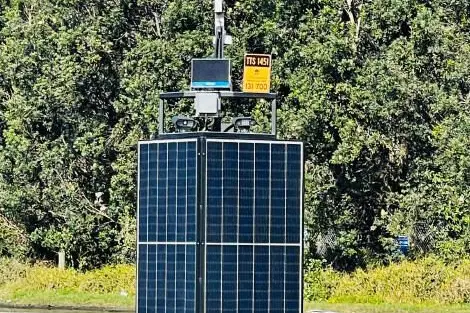
The solar-powered, artificial intelligence-enabled technology was designed and built in Australia, with the first iteration of the world-leading software developed by staff at Transport for NSW.
Images of heavy vehicles are taken by the cameras which then classify the type of vehicle in transit and the type of cargo being transported. This information will enable Transport to better understand freight movements with the aim of assisting in long-term planning for the movement of goods in NSW.
The information is helping Transport for NSW shape the future of freight. As the demand for goods grows with our increasing population, Transport is making it easier for businesses to move freight in and out of our ports and airports, around our regions, and across our state.
These machine learning cameras take high-definition pictures of heavy vehicles and then classify the type of vehicle.
There is a radar sensor and camera on the unit that takes a picture of the heavy vehicles when certain criteria are met.
After the picture is taken, artificial intelligence within the unit can tell the difference between different types of heavy vehicles, for example a container carrying heavy vehicle, B-Double or Semi-trailer.
The units are also able to track changes in load. If a shipping container truck entered a location carrying one container and left with two containers the platform contains a record of this change.
They are not speed cameras, do not take images of public vehicles/commuters and are not mobile phone detection cameras.
• These machine learning cameras take high-definition pictures of heavy vehicles and then classify the type of vehicle.
• There is a radar sensor and camera on the unit that takes a picture of the heavy vehicles when certain criteria are met.
• After the picture is taken, artificial intelligence within the unit can tell the difference between different types of heavy vehicles, for example, a container carrying heavy vehicle, B-Double or Semi-trailer.
• The units are also able to track changes in load. If a shipping container truck entered a location carrying one container and left with two containers the platform contains a record of this change.
People who have any questions or would like more information should contact the project team can contact freight@transport.nsw.gov.au www.transport.nsw.gov.au/freight-hub