PHOTO
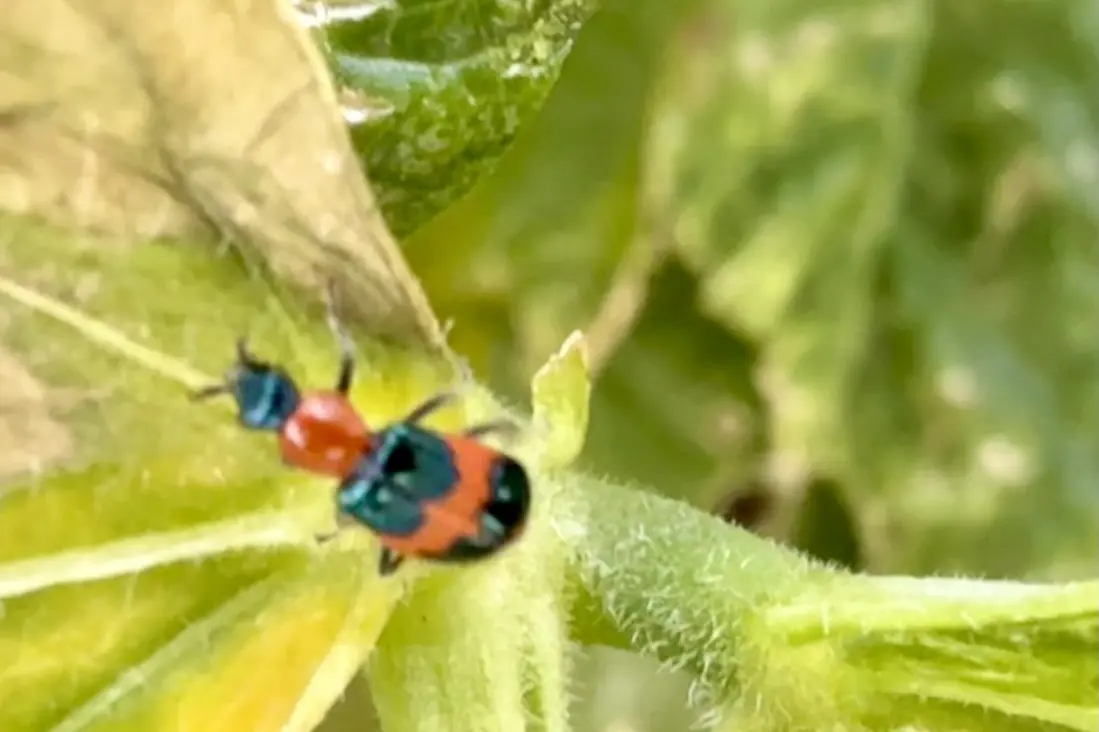
If you’ve seen the Red and Blue Beetle – and yes, that is actually what it’s called – please don’t kill it.
In what is clearly a missed opportunity by scientists to have a fantabulous name for this native wonder, the Red and Blue Beetle exploded in numbers in the Riverina in recent weeks, and local green thumbs and big agriculture are equally pleased.
Hailing from the genus Dicranolaius bellulus, this soft-winged native flower beetle has exploded in numbers this year, and it’s all good news for the local environment.
According to CSIRO research entomologist Dr Adam Slipinski, the Red and Blue Beetle is one of the good guys.
“It’s harmless for sure,” Dr Slipinski said.
“The larva is … predatory, and the adult is … feeding on nectar and pollen.”
Cotton NSW farmers are also fans of this little warrior.
With 50,000 to 80,000 hectares (more with water availability) of cotton farms in the Murrumbidgee Valley, the Lachlan Valley, and developing areas in the Murray Valley, Cotton NSW says the native Red and Blue Beetle is a welcome sight in Hay, Carrathool, Darlington Point, Whitton and Coleambally.
“The Red and Blue Beetle have been quite high in numbers this year, but the peak was February and as we are getting closer to harvest towards the end of April and into early May, their numbers have started to go down,” said regional extension officer for Cotton Info Southern New South Wales, Kieran O’Keeffe.
“They’re quite good in that they keep populations like Silver Leaf Whitefly and Heliothis (Budworms) down as they attack those.
“These (Red and Blue Beetle) insects are beneficial and play a really important role in reducing pesticide use.
“Most crops now would probably get only one or two insecticides, whereas before we had transgenic cotton we would have probably 20 insecticides which was unsustainable.”
Thanks to some clever farming and technological advancement, cotton crops incorporate a Bt gene from the soil bacterium Bacillus thuringiensis (Bt), which produces proteins toxic to specific insect pests.
Since 1995, genetic engineering has allowed these transgenic crops to produce their own insecticide that targets larvae from unwanted insects, while remaining harmless to humans and non-target organisms.
These crops have revolutionised agriculture by improving yields, reducing chemical pesticide reliance, and lowering environmental impact.
“We’ve actually had a very good January, February and March, so I’m thinking with bale (per hectare) counts, we could be a little above average, so the overall average of 11 (bales per hectare) but some crops will have at least 14 bales,” Kieran said.
In local towns and cities, the native Red and Blue Beetle have been on a sightseeing tour; you’ve probably seen them on your washing, window screens, and local businesses, even jewellery stores.
Clearly they have a good eye. So for the sake of your backyard, and for our farmers, please enjoy beetle mania while it lasts, but try not to squash it in the process.