PHOTO
The Narrandera Musical and Dramatic Society was one of the biggest forms of entertainment in the town in the 1930s and often had up to 100 entertainers on stage.
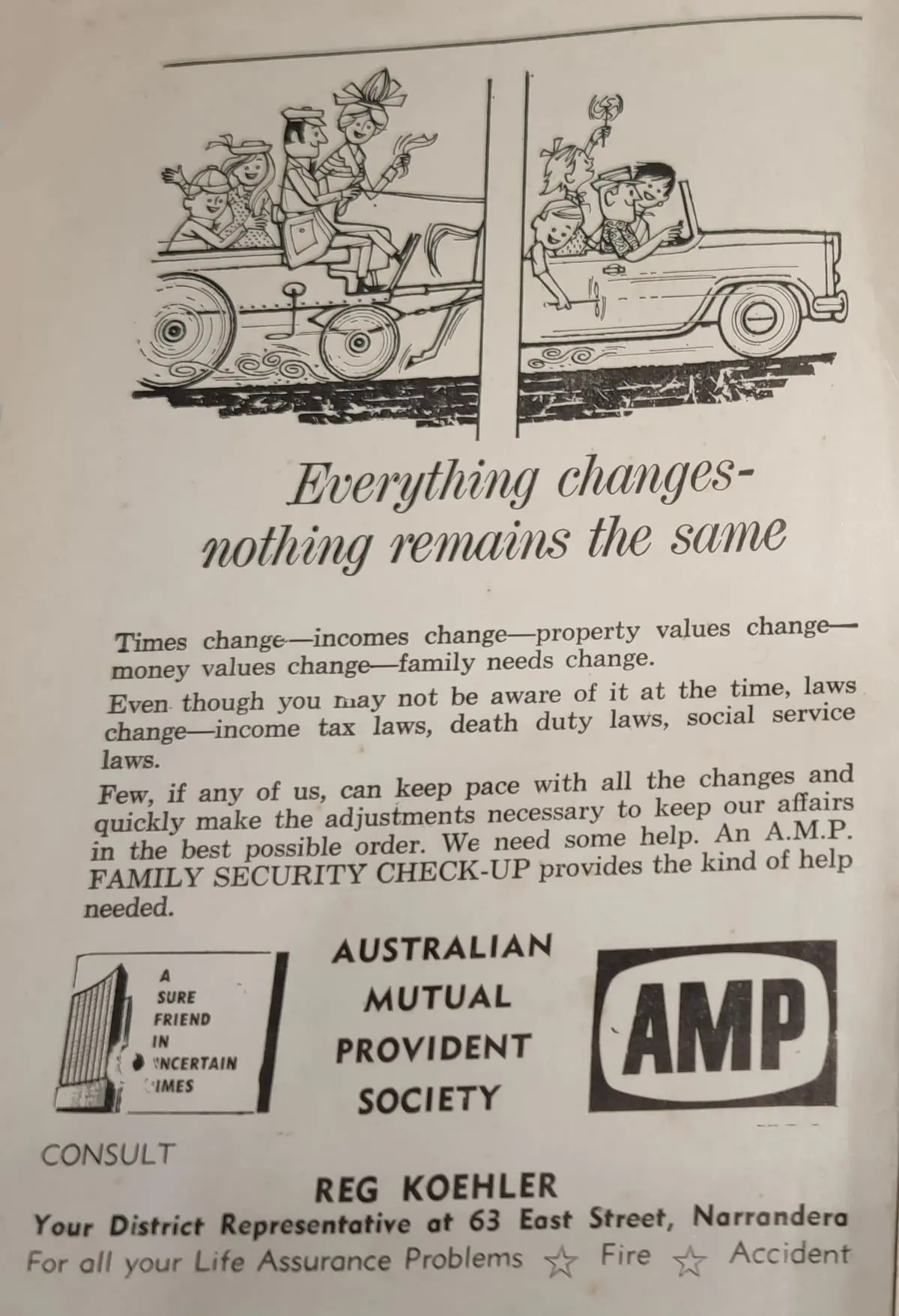
Glen Ward’s Lost Narrandera page on Facebook recently shared a 1963 program from Felicity Brown Ling, daughter of former Narrandera pharmacy owner Gordon Brown and his wife Margaret.
It was given to Ms Ling by Elaine Gilligan (Alan Gilligan is credited as producer) and Syd Young's name is written on the front cover.
The Youngs (Optometrists), Gilligans (Teachers) and Ms Ling’s parents Gordon and Margaret Brown were great friends for decades even after all the families left Narrandera.
According to historical files at the Narrandera Argus a decade before this event the society was getting ready in July 1953 to celebrate its silver jubilee.
It performed “No No Nanette at Narrandera’s Plaza Theatre (now the CRC Church) on two nights, Monday and Tuesday.
The popular musical comedy attracted large crowds including patrons from Leeton, Griffith, Sandigo, Galore, Grong Grong and Junee. The production was in the capable hands of Mrs Frances King.
Playing in her first major role, the youthful Adrienne Smith presented a perfect interpretation of 'Nanette,' and was roundly applauded.
Fred Bratton, in the role of 'Jimmy Smith' added to his laurels as a comedian of high standard.
Pearl de Brie as 'Pauline'' (the cook) delighted the audience with her antics. Pearl owned a women’s fashion store in the location of Joanne Rolfe’s millinery store in East Street for many years.
Ron Deane as 'Tom Trainor' portrayed a difficult part to perfection.
The two 'biggest parts' in the show were Audrey Birmingham and Jim Hagan as 'Lucille' and 'Billy Early,' and their excellent performance's left nothing to be desired.
It was one of many shows staged by the society, which was regarded as one of the best outside the capital cities, often having up to 100 performers on stage.
Its objective was the cultivation of the musical and dramatic arts including operettas, dramas, comedies, musical plays and concerts.
One of its hardest workers was Olive Ward (later Hutchins) who served as secretary.
Its productions numbered two musical comedies a year plus concerts and revues in between.
Permission to produce musical comedies had to be obtained from J C Williamson and the society had to pay considerable royalties for the honour.
Costumes were hired from Sydney and had to be altered by seamstresses. Others working behind the scenes were wardrobe mistresses, scene makers and shifters, ushers, ticket sellers, program sellers and many others.
The orchestras played an integral role and in 1935 there were 11 musicians including the society’s patron Dr H O Lethbridge MBE who played the cello. First violins were Mesdames C Wall and R Harden (Stevenson).
Among the performers who stood out were an ex-professional from England Mr J C Smith from Sydney and Mrs Frances King (Dillon) who appeared as a comedienne.
Dentist Charlie Tilbury was another natural comedian loved by his audiences.
According to Argus records there was also a teachers dramatic group formed in the town in 1963.
The Narrandera branch of the NSW Teachers' Federation, decided to form the dramatic group, with membership limited to members of the teaching profession in Narrandera.
The executive of the already functioning Narrandera Musical and Dramatic Society were approached and considered that the teachers were acting very wisely in presenting a three-act play to provide some entertainment for the Narrandera public at a time when the Musical and Dramatic Society was in recess.
The Teachers' Dramatic Group came into being with the following officers elected:
Chairman Mr K Roberts; Secretary-Treasurer Mr A Neil; Producer Mr. K Harris, Casting committee Mr M Brown and Miss Mr M Cherio, Stage and property manager Mr P Naismith, Assistant stage manager Mr O Unicomb. publicity officer Mr K Failes.
The RSL Hall was booked and this newly-formed group presented the famous farce, 'Tons of Money,' by Will Evans and Valentine.
Local charities benefited from the proceeds of the first play – they were divided between the Hospital Auxiliary and the Ambulance.