PHOTO
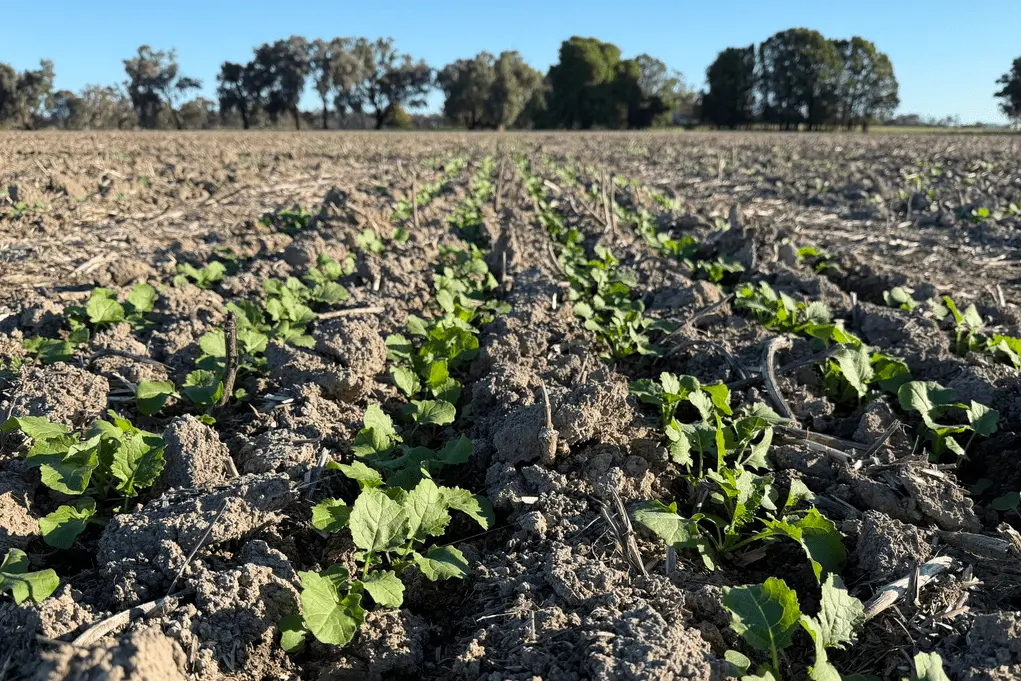
Planting of Australia’s canola crop is almost finished and is off to a strong and early start in all regions bar the northern half of New South Wales, where area is well down due to dry conditions.
It means the 2026-27 canola crop has little chance of reaching the record set in 2022-23 of 8.45 million tonnes from 3.9Mha, or last season’s runner-up of 7.68Mt from 3.7Mha.
Ahead of an Australian Oilseeds Federation report expected this month, and ABARES’ first new-crop estimate due out early June, independent forecaster Lachstock Consulting is calling the 2026-27 crop 6.78Mt.
While canola has a sizeable appetite for applied nitrogen, sources say its expense as a result of the Persian Gulf conflict has done nothing to diminish planted area.
Most crops are between the cotyledon and six-leaf stage, and those in South Australia, Victoria and New South Wales will benefit from at least 10mm of rain forecast for the coming week, and mice are of concern to establishing crops in parts of SA and Western Australia.
Canola on the inner southern, south-west and central slopes of NSW has been sown early and into good subsoil moisture, but dry conditions have limited area on the state’s outer slopes and plains west of the Newell Highway.
In the heavy soils of northern NSW, very little canola has been planted due to ongoing dry conditions.
“A lot of people have pulled the pin on canola, particularly west of the Newell,” Parkes-based PY Agronomy principal Peter Yelland said.
With sheep prices being so strong, some growers who did not have enough soil moisture to plant canola have shown “a little bit of a swing to pulses”, namely lupins and faba beans.
“We’re able to moisture-seek for fabas by planting down to 100mm.
“A lot of people are moving towards a pulse crop for many reasons, urea being one, and weed control being another.”
Intended canola area has been planted east of Parkes, but close to the Newell, Mr Yelland said canola hectares look like being down around 30pc on the planned program, and very little has been planted further west.
Mr Yelland said uncertainty around the season rather than price was limiting demand for urea.
“Most people use it for sowing, and have enough to get them to a certain point.
“A lot of people have a little bit of cover; they might have 20pc of what they require.”
“Rates have been wound back based on soil moisture, and we wouldn’t be using as much as we would have, for example, last year.
“We had zero rain in April, and in March we had very isolated patchy rainfall.
“The rain we got last week is the first decent fall since September last year.”
Sheep, lambs and wool are all fetching high prices at present, and while mixed farmers have hay and grain on-farm to bridge the feed gap until dual-purpose or fodder crops can be grazed, water is a limiting factor.
“The biggest driver for livestock at the moment is groundwater, or lack thereof.
“There are definitely grazing crops in, but nothing’s grazable yet.”